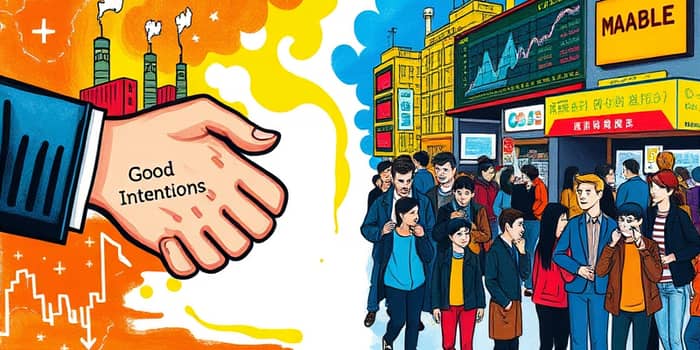
In a world where policies and corporate strategies often begin with the best of motives, reality can quickly intervene. From government programs to brand marketing, the path from aspiration to outcome is littered with surprises, trade-offs, and sometimes outright failures.
Understanding why well-meaning initiatives can backfire under the inexorable forces of supply, demand, and human behavior is essential for policymakers, business leaders, and citizens alike.
Economists remind us that the market is an astonishing mechanism for harnessing self-interest for social goods, coordinating countless individual choices into coherent outcomes.
When planners attempt to override or direct these emergent patterns, they risk triggering unintended policy consequences. Thomas Sowell famously criticized the “morally self-anointed” who focus on benevolent goals while ignoring systemic feedback.
Historical examples abound where legislation meant to help vulnerable groups ends up creating new problems.
Consider minimum wage laws. The intention is to lift incomes for the most vulnerable. Yet, concentrated costs and diffuse benefits mean that while some workers earn more, others—especially those with fewer skills—lose their jobs or see reduced hours.
Similarly, a 1% tax on stock buybacks aims to push firms toward productive investment. In practice, companies may simply substitute one form of financial engineering for another, or even accelerate buybacks to maintain government revenue streams.
In recent years, many companies have embraced environmental, social, and governance (ESG) goals, hoping to align profits with broader social missions. Yet short-term market pressures for quarterly results often clash with these long-term commitments.
Yvon Chouinard of Patagonia highlighted this tension when he debated taking the company public. Investors demand growth and returns, which can dilute or even reverse the original purpose.
When corporate mission statements promise sweeping social change, consumers and activists become skeptical. This distrust can undermine genuine efforts, leading to consumer cynicism and weakened brand impact.
Even individuals with the noblest motivations struggle to translate plans into action. Behavioral economists point to myopic decision-making, where immediate gratification outweighs future benefits.
People may endorse energy-saving measures or healthy diets in principle but revert to old habits when incentives are misaligned. Nudges and default options can help, but they rarely replace the need for robust incentive structures.
Policymakers face a classic dilemma: policies that help many a little and harm a few a lot generate fierce opposition from the harmed minority. This principle of diffused benefits and concentrated costs explains why well-designed reforms often stall in legislative bodies.
The government tobacco settlement illustrates this dynamic. States became reliant on tobacco tax revenues even as they aimed to reduce smoking, creating contradictory incentives and slowing progress.
While the gap between intent and reality is formidable, certain principles can improve the odds of success:
For corporate leaders, aligning purpose with profits means embedding social goals into business models, not just communications. Pay-for-performance structures can reward sustainability metrics alongside financial targets.
Governments can pilot reforms in limited settings, gathering data and adjusting before scaling. This incremental approach reduces the risk of large-scale failures.
No policy or corporate program can guarantee perfect results. Acknowledging the limits of planning and the power of emergent market forces demands continuous learning and agile adaptation.
By combining rigorous economic analysis with humility about unintended effects, leaders can design interventions that better navigate the complex interplay of human behavior, incentives, and market realities. In doing so, they stand a greater chance of turning good intentions into lasting, positive outcomes.
References