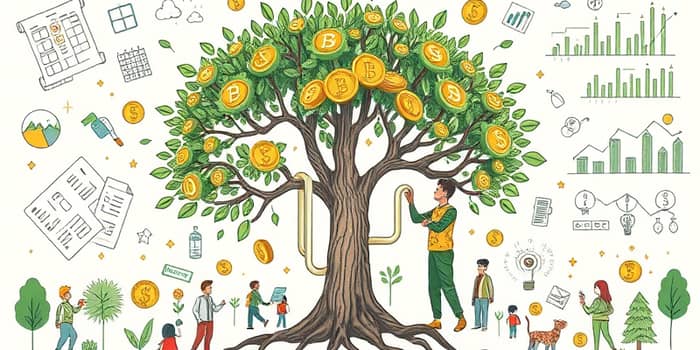
In a world where capital and creativity converge, ethical investing emerges as a canvas for designers and investors to co-create positive change. This article guides you through an integrated, design-inspired process that aligns financial decisions with meaningful impact.
Ethical investing refers to the strategic allocation of capital toward ventures that reflect one’s moral, social, or environmental values, while still aiming for robust financial performance. It overlaps with Socially Responsible Investing (SRI), ESG investing (Environmental, Social, Governance), impact investing, and faith-based portfolios. Before diving in, clarify your own interpretation of “ethical.”
Key categories include:
SRI typically excludes negative sectors like fossil fuels, tobacco, and weapons, while impact investing targets measurable outcomes on pressing issues. Faith-based approaches align with religious doctrines, further broadening the spectrum of choices.
Ethical investing has matured from niche experimentation into a cornerstone of mainstream finance. As of Q3 2025, global sustainable fund assets reached $3.7 trillion, even amid net outflows of $55 billion. The US and Europe remain the dominant markets.
In North America, ESG mutual funds and ETFs totaled $617.44 billion by September 2025. Projections indicate ESG assets will surge past $33.9 trillion worldwide by 2026, representing over 20% of total assets under management. Approximately 90% of S&P 500 companies now issue sustainability reports, with 89% of investors factoring ESG criteria into decisions.
Despite political headwinds and occasional underperformance fears, 73% of asset managers anticipate sustainable market expansion over the next two years. Stewardship policies now cover 79% of US assets, nearing $41.5 trillion.
Just as designers begin with a mood board, ethical investors start with a clear values statement. Define your ethical priorities—whether climate action, social justice, or faith-based guidelines—and document them as guiding principles.
Research and curation parallel client project scouting: leverage sustainability reports, independent ESG ratings, and specialized analytics. Leverage AI-driven ESG data analytics to uncover hidden risks and opportunities.
Treat portfolio construction as a designed system:
Engage stakeholders through shareholder activism—proxy voting, management dialogue, and public campaigns—to influence corporate behavior. Integrate stakeholder feedback into investment design for continuous alignment.
Adopt these practical strategies to operationalize your ethical investing vision:
Draft an ethical investing policy statement that outlines your values, priorities, exclusion criteria, and review schedules. Employ robust risk management—diversify assets, plan for liquidity constraints, and conduct scenario analysis.
Measure outcomes with standardized impact metrics such as SDG alignment, carbon footprint reductions, and community impact assessments. Embrace digital tools—AI-powered analytics and blockchain verification—to combat greenwashing and demand transparent reporting.
Despite rapid growth, the field faces definitional ambiguity: ethical standards differ across cultures, industries, and belief systems. Performance debates persist: long-term data often supports parity or outperformance, but short-term volatility can trigger investor anxiety and fund outflows.
Greenwashing remains a critical concern. Regulators are tightening rules on sustainability claims, and investors must foster transparent data-driven decision making by insisting on independent verification and clear disclosure.
Political polarization affects market sentiment. Anti-ESG legislation in some regions complicates stewardship efforts. Data quality issues also challenge impact measurement, underscoring the need for standardized metrics and reliable databases.
Several themes are shaping the next wave of ethical investing:
1. Climate adaptation & clean energy: Global infrastructure spending on energy is set to top $1.5 trillion in 2025, up 6% from the previous year.
2. Nature & biodiversity: Regenerative agriculture and natural capital preservation drive investment in conservation-focused ventures.
3. ESG regulation & reporting: Harmonization and stricter standards accelerate transparency, requiring brands and funds to adopt rigorous disclosure practices.
4. Transition investing: Supporting legacy sectors as they pivot toward sustainable operations, from oil and gas to green hydrogen.
5. DEI emphasis: Workplace equity, inclusive governance, and community impact are now core evaluation criteria.
6. Ethical tech & AI: Both as analytical tools and as emerging investment themes in clean technology and ethical artificial intelligence.
7. Consumer influence: With 76% of consumers ready to boycott unethical companies, brand reputation and shareholder advocacy are more interconnected than ever.
Ethical investing benefits from design thinking’s human-centered methodologies:
Empathy: Begin by understanding the social or environmental challenges your capital addresses, similar to framing a design problem.
Iteration: Continuously refine your portfolio based on performance data and stakeholder feedback. Embrace continuous portfolio iteration cycles to optimize both impact and returns.
Systems thinking: View your investments as components in a larger ecosystem, assessing interdependencies across sectors and communities.
Storytelling: Use compelling narratives, case studies, and data visualizations to communicate your strategy and demonstrate impact to clients and stakeholders.
By applying a designer’s mindset—empathy, iteration, systems approach, and narrative—you can transform ethical investing from an abstract ideal into an actionable, dynamic practice. Your portfolio becomes a living design project, evolving to meet emerging challenges and deliver both social good and financial growth.
References