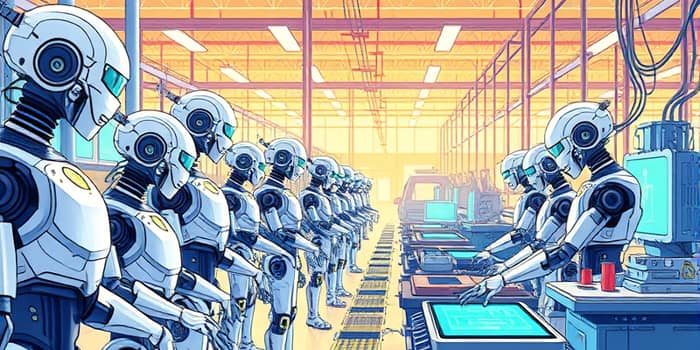
In today’s fast-paced industrial landscape, organizations face mounting pressure to do more with less while maintaining uncompromising quality. This article explores how businesses can harness programmable machines and AI-driven workflows to unlock transformative productivity increases while fostering innovation, resilience, and sustainable growth.
Robotics refers to the deployment of programmable machines—ranging from articulated arms in factories to autonomous mobile robots in warehouses—that perform repetitive or hazardous tasks with precision. Automation encompasses both hardware and software solutions, including robotic process automation (RPA), artificial intelligence, and machine learning, which reduce or eliminate manual interventions in workflows.
By merging physical and digital automation, companies can streamline entire value chains: from predictive maintenance on the shop floor to real-time analytics in back-office finance departments. This convergence underpins Industry 4.0 and lays the foundation for next-generation productivity.
The global industrial automation market is on pace to grow at a 10.8% CAGR from 2025 to 2030, driven by rising labor costs, AI integration, and the proliferation of connected devices. In 2024, the market reached $94.54 billion, while the robotic process automation sector soared to $22.8 billion, boasting a projected CAGR of 43.9% through 2030.
Asia-Pacific leads with 39% of global revenues, fueled by massive investments in China, South Korea, and Japan. In North America, orders for industrial robots reached 17,635 units in the first half of 2025—valued at $1.094 billion—marked by a 42% surge in unit volume and a 78% jump in value, particularly from automotive OEMs. Collaborative robots (cobots) now represent 11.6% of orders, rising to over 20% in life sciences and food processing sectors.
More than 90% of workers report that automation tools help them work faster and more accurately. Companies implementing RPA achieve average first-year ROIs ranging from 30% to 200%, with many experiencing a 22% reduction in operating costs overall. Direct time savings can reach up to 360 hours per employee annually, enabling teams to focus on strategic, value-added tasks.
Below is a summary of typical ROI ranges and implementation timelines across key sectors:
Automation often raises concerns about job displacement, but the reality is more balanced: by 2030, while 92 million roles may be displaced globally, automation is expected to create 170 million new positions—a net gain of 78 million jobs. Nearly half of manufacturing operators will work side by side with robots by 2034, and 83% of employees report reduced burnout thanks to AI assistance in mundane tasks.
Successful automation hinges not just on machines, but on a comprehensive workforce strategy that prioritizes continuous skills development and change management. Companies leading in automation invest equally in technology and people.
Despite clear benefits, up to 70% of digital transformation and automation initiatives fail to meet objectives due to resistance to change, technical complexity, or unclear ROI metrics. Rising labor costs can also outpace output gains if automation projects are not carefully scoped and monitored.
To overcome these obstacles, organizations should adopt a clear governance framework with executive sponsorship, data-driven performance dashboards, and iterative pilot programs. Equally important is to balance technology with human insight throughout deployment, ensuring that process owners and frontline teams remain actively engaged.
Hyperautomation—the combination of RPA, AI, and IIoT—is projected to become a $600 billion market by 2025. McKinsey estimates AI-driven productivity gains could add $4.4 trillion in value by scaling from pilot projects to enterprise-wide solutions. As global competition intensifies, organizations that hesitate risk falling behind.
To lead in this era of rapid change, start with high-impact, high-ROI workflows: packaging, quality inspection, finance reconciliation, or customer service bots. Measure outcomes rigorously and refine continuously. Then scale capabilities responsibly, leveraging Robotics-as-a-Service to manage financial exposure and accelerate time-to-value.
Embrace robotics and automation not merely as cost-cutting tools but as catalysts for creativity, safety, and growth. By investing strategically today, your organization can deliver exceptional performance gains while empowering employees to take on more meaningful, value-added roles.
Invest wisely, reskill broadly, and innovate continually to ensure your company thrives in a world where robotics, AI, and human ingenuity converge to redefine what’s possible.
References