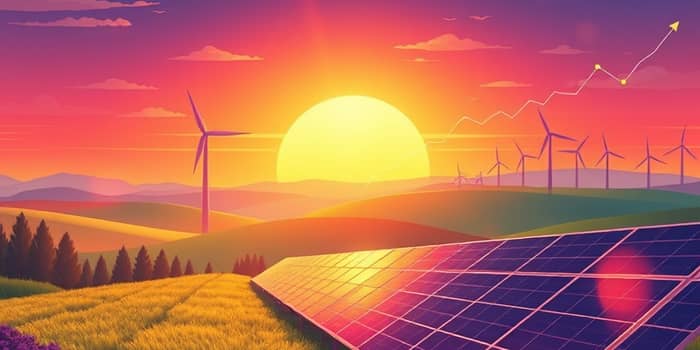
In an era defined by the urgent need for sustainable development, renewable energy has emerged as a compelling investment frontier. This article explores the financial, policy, and technological dynamics shaping the clean energy landscape as global investors seek both returns and positive impact.
Recent data indicates a seismic shift in capital allocation toward clean energy. The IEA projects to reach nearly $2.2 trillion by 2025 for clean energy and grid investment, nearly doubling fossil fuel spending. This surge is driven by an expanding definition of clean energy, including solar, wind, grid storage, nuclear, and low-emissions fuels.
China dominates with a 44% share of new clean energy commitments in the first half of 2025, while Europe’s offshore wind investment climbed 63% year-on-year. Meanwhile, emerging economies are installing more solar and wind capacity than the US or EU during the same period, despite higher financing costs.
Investors are drawn not only by environmental benefits but also by competitive financial returns. Operational renewable portfolios in developed markets typically yield operational renewable portfolios deliver consistent returns of 8.5–10% annually on a buy-and-hold basis. Offshore wind has outperformed, offering 12–15% yearly returns over the past five years.
A comparative study shows renewable assets often exhibit lower volatility than traditional equities and fossil fuel investments. Wind resource variability has a standard deviation under 2% over decade spans, and solar even less, making revenue streams relatively predictable.
Nevertheless, investors must navigate a variety of risk factors, including technology evolution, revenue curtailment in oversupplied markets, and negative pricing episodes in places like Spain and Brazil.
Government actions remain pivotal in shaping investment flows. Regulators use tax incentives, auctions, and feed-in tariffs to bolster project viability. The US saw a 36% drop in clean energy commitments during H1 2025 following rolled-back tax credits, illustrating the sensitivity to policy shifts.
In H1 2025, investment in new renewables projects hit $386 billion, marking a 10% year-on-year rise globally. The US, having allocated $265 billion in clean technologies in 2024, witnessed a downturn amid tax credit reforms, highlighting the need for stable long-term frameworks.
Mobilizing $1.3 trillion for low-emissions projects in developing nations by 2035 will require innovative financing to reduce the cost of capital and de-risk investments against political and currency fluctuations.
Emerging economies are leapfrogging legacy infrastructure, installing more wind and solar capacity in H1 2025 than traditional leaders. Yet, the cost of capital remains up to 80% higher than in advanced economies, translating into higher energy prices and affecting project bankability.
Local currency risks, lower credit ratings, and nascent regulatory frameworks add complexity. Development finance institutions, multilateral banks, and blended financing mechanisms have become critical partners in bridging the funding gap and unlocking private capital.
Despite higher financing costs, regions like Southeast Asia and Sub-Saharan Africa are drawing investor interest. Vietnam, Egypt, and Kenya are emerging as solar hubs, with joint ventures financing gigawatt-scale projects that blend renewables and storage to ensure grid reliability.
On the current trajectory, global additions of low-carbon capacity could average 1,000 GW per year before 2030, driven by plummeting technology costs. Solar module prices are at historic lows and continue to fall as manufacturing scales, supporting continued reductions in solar module costs that underpin robust returns.
Capital is increasingly seeking platform acquisitions to gain scale, access development pipelines, and secure talent. Investors that align long-term visions with emerging policy frameworks and community engagement models will capture the greatest value.
In conclusion, the renewable energy sector stands at a historic inflection point. Robust financial returns, underpinned by stable resource exposure and accelerating technology improvements, are attracting global capital. Policymakers and industry leaders must collaborate to lower the cost of capital, de-risk emerging market opportunities, and scale innovations that will define energy systems for decades to come. For investors willing to navigate evolving policy landscapes and embrace sustainable practices, renewable energy represents both a powerful investment thesis and a pathway to a resilient, decarbonized future.
References