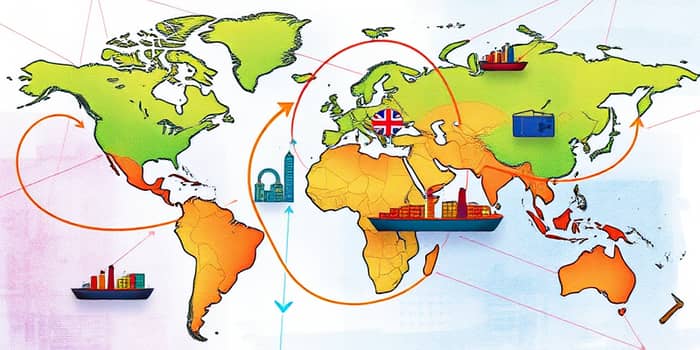
In an era defined by rapidly evolving alliances and economic realignments, businesses and investors face unprecedented challenges. Understanding the complex interplay of sanctions, tariffs, and shifting trade patterns is crucial to preserving stability and unlocking new opportunities.
Heading into 2025, global growth is forecast at just 2.3%, the weakest since the 2008 crisis outside of recession years. Persistent inflation in economies such as the U.S. and U.K. is forcing central banks into tighter policies, further stoking market volatility and investor anxiety. Yet while headline uncertainty remains elevated, regional indicators reveal pockets of resilience. Southeast Asian manufacturing, for example, has seen modest upticks in output as firms diversify away from traditional hubs. This uneven picture underscores the need for nuanced strategies that account for both macro risks and micro opportunities.
The ongoing Russia-Ukraine conflict continues to roil commodity markets, driving energy prices into volatile swings. At the same time, U.S.-China tensions have escalated, with average U.S. tariffs climbing to 18.2%—a high not seen since 1934. These developments have catalyzed a broader trend toward de-globalization and fragmentation. Companies are now engaging in “friend-shoring,” relocating production to politically reliable partners such as Vietnam and Mexico, even at increased cost. Meanwhile, extraterritorial sanctions from multiple powers are forcing complex trade diversions and the creation of alternative financial networks.
One striking example is India’s export sector. Facing U.S. levies that touch 66% of its shipments, New Delhi anticipates export revenues falling from $86.5 billion to $50 billion in FY2026. In response, Indian firms are redirecting shipments toward China, Southeast Asia, and Europe, reshaping long-standing supply chain dynamics.
The technology industry exemplifies the costs of fragmentation. With dual product lines for distinct geopolitical blocs, R&D expenses are surging, and scale economies are eroding. In the energy realm, coordinated Western sanctions on Russian LNG and natural gas have spurred massive investments in renewables as countries seek greater energy independence and security. Financial institutions, meanwhile, are grappling with amplified compliance burdens and the need for enhanced due diligence under new “know your customer” mandates.
In this fragmented environment, scenario planning has become indispensable. Leading firms are stress-testing operations against varied geopolitical shocks, incorporating dynamic supply chain realignment and automation to maintain flexibility. Key tactics include near-shoring to adjacent markets, diversifying supplier networks across multiple regions, and maintaining strategic stockpiles of critical inputs. These measures seek to balance the trade-off between cost efficiency and risk mitigation, ensuring that disruptions—whether from sanctions, trade disputes or conflict—have limited operational fallout.
Governments are also playing a more active role. Incentives for domestic manufacturing, tax credits for reshoring, and bilateral trade agreements are reshaping comparative advantages. Companies that engage proactively with policymakers gain preferential access to subsidies and expedited approval processes.
For investors, political risk has reemerged as a defining factor. Traditional portfolios heavily weighted toward global equities and commodities now require carving out allocations for geopolitical hedges. These can include positions in hard assets, tactical equity shorts in vulnerable sectors, and currency strategies designed to capitalize on regional decoupling. In emerging markets, careful evaluation of sanction exposure and tariff vulnerability is critical. Both credit and equity analysts are adjusting models to incorporate scenario-based stress tests for sudden policy shifts.
Amid evolving regulations, firms are strengthening their government affairs capabilities. Robust public policy teams engage in direct dialogue with regulators, ensuring that corporate strategies align with national security priorities. Concurrently, the proliferation of state-sponsored cyber threats has elevated information security to board-level concern. Enterprises are fortifying digital defenses, integrating advanced threat detection, and partnering with security agencies to counter espionage and supply chain backdoors.
Will fragmentation endure or give way to a new equilibrium? The answer likely lies in a hybrid model of segmented globalization, where regional trade blocs coexist with targeted multilateral agreements. Over time, technological advances—such as blockchain-enabled trade financing—may bridge some divides. At the same time, the accelerating shift to renewables and carbon-neutral policies, driven by geopolitical friction over energy supplies, could unite disparate powers around shared climate goals.
Ultimately, success in this fractured landscape demands continual adaptation. Embracing diversified regional trade alliances and adopting agile operating models allows businesses and investors to not just survive but thrive amid incessant change. By blending strategic foresight with tactical flexibility, organizations can transform geopolitical uncertainty from a threat into a catalyst for innovation and growth.
References