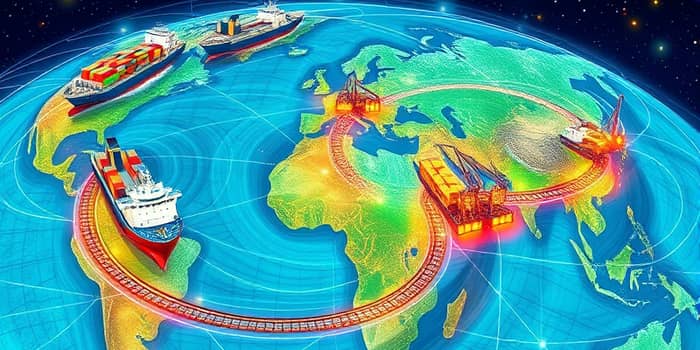
In 2025, we stand at a pivotal moment in the evolution of global commerce. Emerging corridors, technological breakthroughs, and shifting economic power centers are reshaping how goods and services move around our interconnected world.
Against a backdrop of geopolitical tension and policy unpredictability, trade continues its ascent. Nations and businesses alike are forging new pathways, forging alliances, and embracing resilience despite geopolitical volatility to capture growth in uncharted markets.
Mid-year data reveal a remarkable story: global trade rose 2.5% in Q2 2025, pushing total trade values toward unprecedented highs. Merchandise exports among G20 nations grew 2.6%, while services led the charge with exports climbing 4.7% and imports up 2.9%. The World Trade Organization forecasts a 2.7% expansion in goods trade this year, underscoring a broader shift toward digital and service-driven flows.
The United States recorded $277.3 billion in exports and $337.5 billion in imports in June, marking a 38.3% year-to-date rise in its trade deficit. China’s exports grew 2.5%, while imports surged 4.7%, driven by demand for semiconductors, high-tech goods, and energy products.
Healthcare and IT equipment trade volumes are projected to exceed 10% growth through the year, reflecting accelerated investment in medical infrastructure and digital transformation globally. Despite policy headwinds, global trade expanded by $500 billion in the first half of 2025, a testament to enduring demand and adaptive supply chains.
Traditional routes like the Suez and Malacca Straits face competition from innovative corridors designed for speed, sustainability, and geopolitical balance. Leading the pack is the Indo-Mediterranean Corridor, linking South Asia, the Middle East, and Europe via integrated rail and maritime networks.
Meanwhile, the African Continental Free Trade Area is unlocking intra-African commerce through tariff removal and regulatory harmonization. Complemented by the Belt and Road Initiative’s significant investments in ports, railways, and highways, these corridors are transforming how goods traverse Asia, Europe, and Africa.
Latin American exporters are also diversifying their pathways via the Pacific Alliance, pivoting toward Asia-Pacific markets and reinforcing ties with European partners. Intraregional trade among ASEAN, China, and the Middle East accelerates under the RCEP and the ASEAN Economic Community frameworks.
The current climate is defined by maritime trade growth slows sharply. Rates dropped from 2.2% in 2024 to 0.5% in 2025. Congestion at choke points like Suez and Panama has intensified rerouting and regulatory friction, forcing businesses to rethink shipping strategies.
These dynamics are not merely reactive; they drive purposeful diversification of supply chains, enabling companies to safeguard operations against sudden policy shifts and logistical bottlenecks.
Trade is no longer just about moving containers; it’s about moving data. advanced tracking and automation powered by blockchain, IoT, and AI are streamlining customs, compliance, and end-to-end visibility.
Digital trade volumes are eclipsing traditional goods flows as e-commerce platforms integrate emerging markets into global supply chains. Logistics services alone exceed $10 trillion in value, with freight, travel, and business services outpacing physical exports.
Despite robust growth, challenges persist. Infrastructure gaps in emerging hubs require billions in additional funding. Regulatory harmonization across corridors remains a work in progress. Geopolitical tensions could yet derail nascent alliances.
However, the opportunities are profound. Diversified supply chains reduce systemic risk. Businesses and investors can leverage new corridors to access fast‐growing markets in ASEAN, the Middle East, and Africa. By embedding adaptable strategies and sustainable practices, stakeholders position themselves to thrive in a world where agility and innovation are paramount.
The IMF projects global economic growth of 3.2% in 2025, with Asia’s export volumes rising up to 7.4% even as Europe faces modest contraction. Emerging regions will continue driving trade momentum, buffered by intra-regional integration and digital transformation.
As the global trade landscape is reimagined, the convergence of new routes, evolving rules, and cutting-edge technology offers a blueprint for inclusive, sustainable growth. The journey ahead will demand collaboration, foresight, and unwavering commitment to innovation—but the rewards promise to reshape prosperity for generations to come.
References