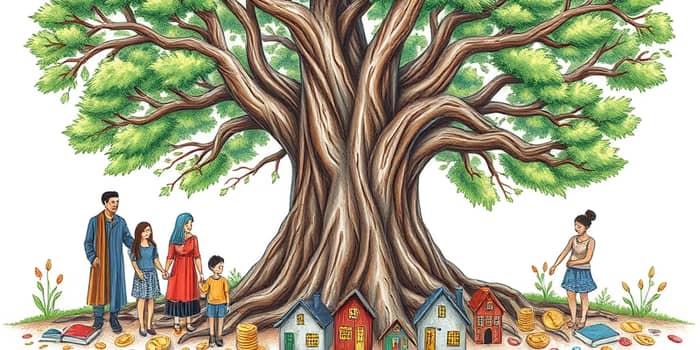
Every family holds the potential to create an inheritance that transcends bank balances. True legacy encompasses not only assets but also the wisdom, values, and relationships that bind generations together. By understanding how to accumulate, protect, and transfer wealth—both tangible and intangible—you can craft a future where descendants thrive on more than just a financial cushion.
At its core, generational wealth refers to the accumulated assets passed down from one generation to the next. These assets may include savings, real estate, businesses, or life insurance policies. Yet, the definition extends far beyond monetary holdings to encompass intellectual capital, social connections, and family values.
Direct transfers such as inheritances and gifts form one avenue. Indirect transfers—like paying for education or seeding a startup—can empower heirs to build their own fortunes. Recognizing both forms is essential for a holistic approach to legacy-building.
Generational wealth can provide a powerful head-start into future generations, enabling access to quality education, safer neighborhoods, and business ventures. However, this advantage is distributed unevenly: the wealthiest 10% of families receive around 72% of intergenerational transfers.
Structural barriers—rooted in historical discrimination and policy biases—have limited wealth accumulation for many communities. Acknowledging these disparities is the first step toward crafting strategies that address inequity while building personal legacies.
True legacy extends into four key domains:
Assets alone seldom guarantee lasting prosperity. Equally vital is the transmission of knowledge and character. Start by teaching budgeting, financial planning, and investment basics from an early age. Pair this with stories of how wealth was built—lessons in perseverance, risk-taking, and ethical decision-making.
Family retreats or workshops can serve as interactive forums for teach decision-making and critical thinking. Involve young adults in real-world financial decisions—reviewing investment portfolios or contributing to philanthropic strategies.
The Rockefeller family exemplifies how strategic diversification and family education can sustain wealth across multiple generations. Beginning with oil, they expanded into banking, real estate, and philanthropy, all governed by a unifying set of principles.
Modern entrepreneurs like Daymond John and Rihanna turned individual success into platforms for generational growth. Their approaches emphasize innovation, brand building, and reinvestment—showing that starting small does not preclude creating vast legacies.
Generational wealth carries a moral imperative: to use resources not only for personal gain but also for community uplift. Philanthropic trusts and family foundations can channel capital toward education, health, and social justice initiatives.
By integrating social missions within wealth strategies, families can address the systemic imbalances that limit opportunity. This approach fosters unity and instills a sense of shared purpose among heirs.
1. Identify Your Vision: Clarify the mix of financial assets, values, and social goals you wish to pass on. What legacy matters most?
2. Create a Plan: Map out saving targets, investment allocations, and legal structures. Determine time frames and milestones for each objective.
3. Build Consistently: Automate savings and re-invest profits from business ventures. Diversify across asset classes to balance growth and stability.
4. Educate Heirs: Schedule regular workshops, mentoring sessions, and discussions about money, risk, and responsibility.
5. Monitor and Adapt: Review performance, update estate documents, and refine strategies in response to evolving family needs and regulatory changes.
As societies and economies change, so do the forms and meanings of wealth. Digital assets, intellectual property, and impact investing are reshaping how families accumulate and transfer value. Staying informed about new vehicles—such as cryptocurrency trusts or green investment funds—ensures your legacy remains relevant and resilient.
Ultimately, generational wealth is a tapestry woven from both tangible resources and the intangible strands of wisdom, unity, and purpose. By mindfully cultivating each element, you create more than an inheritance—you establish a living heritage that endures through time.
References