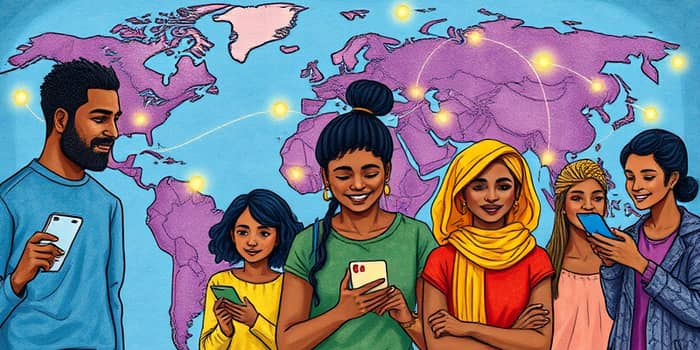
Every individual deserves access to tools that foster growth and security. Financial inclusion transforms lives by unlocking opportunities, nurturing entrepreneurship, and fortifying communities. Yet, significant gaps persist around the world, leaving millions without essential services. This article examines definitions, progress, barriers, and actionable strategies for creating an inclusive financial ecosystem that benefits everyone.
Financial inclusion means ensuring that all individuals and businesses can access affordable, responsible financial services that address their needs. Over time, focus has shifted from merely counting account holders to prioritizing economic resilience and opportunity. Financial health gauges the ability to manage obligations confidently and plan for the future.
Consider the story of Amina, a smallholder farmer in rural Kenya. After receiving training on digital wallets, she began saving in a mobile account, enabling her to purchase quality seeds and respond to emergencies without resorting to high-interest loans. This example illustrates how quality access goes beyond ownership to drive life-changing outcomes.
Initial efforts centered on expanding access—issuing bank accounts and basic payment services. Today, outcome-driven approaches measure success by improvements in quality of life, such as increased household savings, smooth payment flows, and enhanced disaster resilience. Policymakers, practitioners, and researchers advocate for integrating financial services with social protection, education, and health systems to deliver holistic support.
Recent data show that 79% of adults worldwide hold a financial account (bank, mobile money, or similar), up from 62% in 2014. In low- and middle-income countries (LMICs), account ownership reached 75%, signaling strong momentum. However, the remaining 1.3 billion unbanked represent a hidden toll on economic potential.
More than half of these unbanked adults reside in eight countries: Bangladesh, China, Egypt, India, Indonesia, Mexico, Nigeria, and Pakistan. Women account for 55% of the unbanked, highlighting persistent gender disparities. Within the poorest 40% of households, more than half have no formal financial access, and those with only primary education constitute 62% of the exclusion tally.
Digital payments and savings in LMICs have soared. In just three years, the proportion of adults making or receiving digital payments rose to 60%. Formal saving rates increased by 16 percentage points, reflecting greater trust in mobile money and digital banking platforms. Data show that mobile money users in sub-Saharan Africa save at twice the rate of non-users.
Such trends underscore the transformative power of tailored digital solutions. Yet, progress varies by region, influenced by regulatory environments, infrastructure, and cultural norms.
These regional snapshots reveal both inspiration and urgency. Areas with robust mobile networks and supportive policy frameworks lead, while regions facing infrastructural or regulatory bottlenecks lag behind.
Several factors propel financial inclusion forward:
Data-driven product design is another vital driver. By analyzing transaction patterns and customer feedback, providers can iterate on features that increase engagement and trust. For example, tiered KYC requirements in East Africa allow users to gradually access more services as they build digital footprints.
Collectively, these drivers demonstrate that technology, policy, and collaboration can deliver quality over mere numerical expansion, laying the groundwork for sustainable financial ecosystems. As digital public goods become interoperable across borders, the potential for global financial integration grows.
Despite notable gains, barriers continue to exclude vulnerable populations:
In Latin America, small rural cooperatives struggle to meet formal KYC rules, pushing farmers back into informal networks. In Southeast Asia, digital loan scams have undermined confidence, demonstrating that innovation without oversight can backfire.
Addressing these challenges requires multi-pronged interventions: targeted training programs, gender-sensitive product design, digital infrastructure investments, and clear regulatory frameworks that build consumer confidence. Encouraging community participation in policymaking further ensures solutions are grounded in lived experience.
As the sector matures, measurement evolves beyond account counts to capture usage patterns, financial health outcomes, and resilience. Metrics such as transaction frequency, credit repayment rates, and insurance uptake reflect deeper financial engagement.
Key data sources include the World Bank’s Global Findex Database, offering triennial updates on digital payment trends, saving behaviors, and demographic disaggregation. The IMF’s Financial Access Survey complements with annual supply-side data across 163 economies, including innovation indicators and gender statistics.
National and regional studies—such as central bank reports, microfinance institution surveys, and fintech ecosystem analyses—provide granular insights. These localized perspectives inform tailored policy interventions, from digital ID rollouts to targeted subsidy schemes.
Looking forward, future frameworks emphasize holistic, outcome-driven financial strategies. Integrating climate resilience, social protection, and digital inclusion, policymakers are designing social registries linked to financial accounts, parametric insurance for climate shocks, and micro-savings programs tied to educational incentives. AI-driven credit scoring models are also emerging to expand access while managing risk.
The path to universal financial inclusion demands purposeful collaboration. Practitioners can adopt concrete actions to forge ahead:
Real-world success stories offer inspiration. In Kenya, mobile money platforms lifted millions out of poverty by enabling secure remittances and small business lending. In India, UPI’s open architecture spurred fintech innovation, lowering transaction costs and democratizing payments. Across Latin America, digital cooperatives are piloting climate-indexed savings accounts for farmers.
By embracing these tactics, organizations can empower individuals and communities and catalyze meaningful, measurable change for all. The journey toward comprehensive financial inclusion is ongoing, and every stakeholder—governments, fintech innovators, development agencies, and community leaders—plays a critical role.
With concerted effort, data-driven strategies, and empathetic design, we can build resilient financial ecosystems that leave no one behind. Together, we can ensure that every person, regardless of background, has the tools to manage risks, pursue ambitions, and contribute fully to the global economy.
References