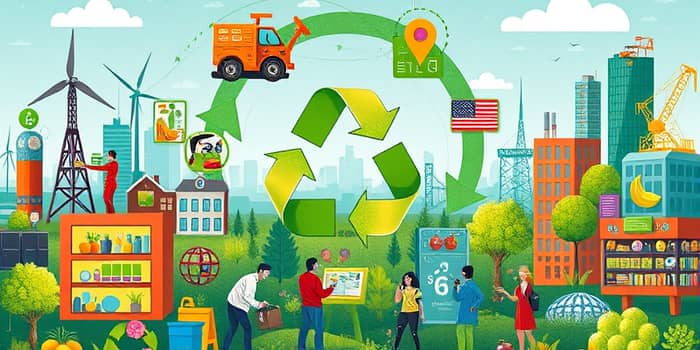
As global economies confront resource constraints and ecological crises, the circular economy emerges as a transformative investment frontier. This paradigm reshapes financial strategies to align profit with planetary health, offering new opportunities for investors, entrepreneurs, and policymakers.
The circular economy rejects the take-make-dispose linear model and pursues a system designed to eliminate waste and keep resources in use through reuse, repair, refurbishment, and recycling. Unlike traditional frameworks, circular systems view materials as enduring assets, embedding longevity and renewal at every stage of production.
This approach spans multiple sectors—supply chains, modular product design, bioplastics, construction, food and packaging, electronics, and digital platforms. By emphasizing design-for-circularity, businesses can unlock residual value, reduce environmental footprints, and foster resilient supply networks.
Robust data underscores the circular economy’s rapid expansion. In 2024, the global market was valued between $638.57 billion and $656.23 billion, with projections soaring to $2.2–$2.66 trillion by 2034–2035 at a CAGR of 13–13.6%. The digital circular market alone is set to grow from $3.56 billion in 2025 to $25.4 billion by 2034, achieving a staggering CAGR of 24.4%. A best-case 95% recycling rate could propel the global potential to $7.9 trillion by 2050.
Regional dynamics show Europe leading growth, closely followed by Asia-Pacific and North America. Governments and corporations are rapidly shifting capital toward circular infrastructure, signaling sustained momentum through the next decade.
Transitioning to circularity demands substantial capital. The EU alone estimates €55 billion per year is needed for infrastructure, innovation, and skills development. To mobilize this financing, investors are leveraging:
Deal volumes stabilized in 2024, reflecting maturity and a focus on quality rather than quantity. Governments, philanthropists, and corporations now collaborate to align circular investments with climate goals, job creation, and competitive advantage.
Circular principles are reshaping entire value chains, with several sectors at the forefront:
Other emerging opportunities include rare earth recycling, water management, and e-waste recovery, each supported by advanced sorting, purification, and traceability technologies.
Technology acts as a powerful enabler of circularity by improving efficiency and transparency. Key drivers include:
AI, robotics, and IoT streamline waste sorting and optimize material flows. Blockchain provides immutable tracking of resources across complex supply networks. Smart packaging and inventory tools minimize spoilage and overproduction in the food sector. Digital platforms accelerate resale, sharing, and recommerce, fundamentally shifting consumer behavior.
Collectively, these innovations enhance traceability, reduce resource consumption, and create data-driven feedback loops that reinforce circular system design.
Despite its promise, the circular economy faces hurdles at scale. Financing gaps are particularly acute in emerging markets, where recycling infrastructure lags and policy frameworks remain fragmented. Sourcing secondary raw materials at consistent quality and purity presents supply chain challenges. Commodity price volatility and shifting regulations introduce market uncertainty.
To overcome these barriers, stakeholders should:
With projected CAGRs of 13–24%, the circular economy offers a compelling growth narrative. By 2050, a fully circular system could unlock up to $5.6 trillion in new global value, drive emission reductions, and create millions of green jobs. The next decade will see investments shift from pilot projects to systemic integration—embedding circularity in product design, supply chain management, and financial portfolios.
Investors and businesses must adopt new business models—including product-as-a-service, take-back schemes, and secondary materials marketplaces—to capture emerging revenue streams. Policymakers should enact robust incentives and standards, while consumers continue demanding transparency and longevity in the products they purchase.
Ultimately, the circular economy transcends environmental stewardship; it represents a resilient, inclusive, and prosperous growth model. By aligning finance with regenerative principles, we can foster sustainable innovation and ensure resources serve current and future generations.
References